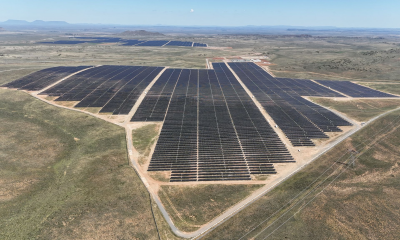
The National Energy Regulator of South Africa (NERSA) has approved Gold Fields’ plan to build a 40 megawatt solar power plant at its South Deep mine in South Africa. The facility will be the biggest renewable self-generation plant in South Africa to date.
The South Deep mine is Gold Field’s last remaining asset in South Africa. The Gold Fields solar plant has the potential to provide around 20% of South Deep’s average electricity consumption. All electricity produced by the facility will be consumed by the mine.
The solar power plant will increase the reliability and affordability of power supply to South Deep, ultimately enhancing the long-term sustainability of the mine
Nick Holland, Gold Fields’ CEO
Currently, all self-generation plants over 1MW are subject to licensing by the national regulator, NERSA. The South African government has announced plans to consider lifting the licensing exemptions threshold for all self generation projects up to 50MW. This is set to ease up pressure on national energy monopoly Eskom which has of late struggled to guarantee energy security with the nation experiencing economically taxing power blackouts.
Gold Fields’ application for a self generation license from NERSA has been more than three years in the making with energy pundits accusing the regulator of bureaucracy and stifling energy independence.
“The approval of this licence sends a strong, positive message to mining companies and their investors, potentially leading to decisions being taken to sustain and grow mining operations in the country, especially in deep-level, underground, marginal mines. Enabling companies to generate their own power also gives Eskom room to address operational issues at its power plants,” commented Nick Holland, Gold Fields’ CEO.
Gold Fields’ green centric energy strategy
Gold Fields’ says their energy objectives are anchored on reliability, availability, cost-effectiveness and clean – which promote a shift to self-generation using renewable energy sources. “We are fully committed to making our contribution towards net-zero emissions,” says Holland.
During 2020, Gold Fields successfully implemented solar and wind power plants, backed by battery storage, at two of its Australian mines, Agnew and Granny Smith, and committed to renewables at its other Australian mines, Gruyere and St Ives, as well as the Salares Norte project in Chile when it starts operations in 2023. All its other mines are also reviewing renewable energy options. Since full commissioning of the Agnew microgrid, renewable electricity averages over 55% of total supply at the mine. During2020, renewable electricity averaged 8% for the Australia region and 3% of total Group electricity. Once the South Deep project is commissioned, renewable’s contribution to the Group total will rise to approximately 11%.
Holland says: “We expect our investment in renewable and low-carbon energy sources to contribute significantly to our carbon emission reductions over the next few years. Power from the South Deep solar plant will partially replace coal-fired electricity from Eskom, enabling us to significantly reduce our Scope 2 carbon emissions.”